Archive for the ‘By Jeannine Buntrock’ Category
Searching for the City of Light
Filed under: By Jeannine Buntrock, Perichoresis | Tags: Jesus, Perichoresis, Trinitarian Theology
 Comments (1)
  A Jewish fable tells the story of a man who left his own home to seek a great “City of Light” far away:
He walked and walked all day. Just before sunset, he stopped and found a likely place to camp for the night. Before going to bed, he carefully placed his shoes on the ground, facing in the direction he was headed. That way, he figured, he would set out in the right direction the next morning.
In the middle of the night, something happened. A stranger came along and turned the man’s shoes around. In the morning the man awoke, put on his shoes and set out on his journey again. Thinking he was headed for the “City of Light,” he walked and walked all day.
Just before sunset, he looked down the road and saw a city that looked rather familiar to him. He entered through the city gate, and found a neighborhood that also looked rather familiar to him. He entered the neighborhood, and came to a house that looked rather familiar to him. He entered into the house. And there he lived happily ever after.
The moral of the story is that the journey of faith is actually a journey homeward.
One of the most beautiful and truly astounding things I have learned from Trinitarian theology has been that when Jesus took on and bound himself to humanity it was for good. He made his home with us just as he secured our home with him.
For so many years, I thought that his humanity ended at the Cross, and that he left, triumphant, for his real home to return on a distant day, when he would gather the faithful and transport them (and only them) to that distant home. The great City of Light.
But oh, the real story is so much better. In an interview, C. Baxter Kruger put it this way:
“We are accustomed to hearing preachers talk about praying to receive Jesus into our lives. For me that is a singular disaster. I think I know what they intend, but there is something very wrong in the vision of Jesus Christ that lies behind the wording. How can we receive someone into our lives in whom we live and move and have our being? That would be like me asking my daughter to receive me into her life. We’ve got it exactly backward. The gospel is not the news that we can receive an absent Jesus into our lives, as if we have life at all without him. The gospel is the news that Jesus Christ has received us into his life. We don’t make Jesus part of our world; he has made us part of his, part of his life and relationship with his Father, part of his anointing in the Spirit, part of his relationship with his creation. It is this reality that summons us to faith and repentance.”
Yet how often are we just like the man in the Jewish fable? — looking for truth outside of ourselves, not knowing that we already possess inside, in the person of Jesus Christ, everything we could ever want or need.
For in him we live and move and have our being. Acts 17:28
Not unlike a fetus. We are quite literally wrapped up, inside and out, in God.
The earth-shattering real story is that Jesus didn’t shed his humanity at the Cross, and he never will. Our humanity is still as much a part of him today — and he of it — as it was then. His union with humanity is for all time and will not end. The Cross showed that humanity can sling and spew its very worst at him, and he won’t let us go.
Because he is here, we are home — though of course we have yet to see the fulfillment of it. There is no distant City of Light to seek.
The true light that gives light to everyone was coming into the world. He was in the world, and though the world was made through him, the world did not recognize him. He came to that which was his own, but his own did not receive him. (John 1:9-11)
It seems to me that not a lot has changed in more than 2,000 years! But every time we witness or experience love, beauty or grace, within or without, it is him. By just raising our consciousness to this regularly, we recognize him, we receive him, we acknowledge him. In so doing, we can make a warmer home for him right now in our world.
It’s hard to imagine Jesus needing anything. But because he has chosen to be in relationship with us, it matters. He wants to feel at home with and in us today. Baxter Kruger noted in his interview that “when one member of the Triune God weeps, the other tastes salt. ” Because Jesus took on our humanity and drew us into his relationship with Father and Spirit, it’s the same with us. When we weep, they taste salt.
When he weeps, do you taste salt?
You can. Wake up. Be aware of him every day. Notice him in places you never have before. By doing so, you make a home for him, and your world will change. More and more, it will be revealed to be the City of Light that it is all because he is here.
~ by Jeannine Buntrock
Above us, in us and at our feet
 I finally got to “The Hobbit 2” over the weekend. With a 12-month old at home, and for a nearly 3-hour movie, it was no easy feat.
My favourite scene in the movie features the movie’s chief protagonist and unlikely hero and hobbit, Bilbo Baggins, and a band of merry (and not so merry) dwarves stumbling about in the darkly enchanted forest of Mirkwood. Their minds have all begun to play tricks on them. They appear to be in a sleepy daze — or very drunk — and are hopelessly lost. Bilbo looks above for the light that will lead them out, and climbs to the top of a tall tree to find it. As he breaks through the canopy of leaves, he takes a deep breath, as if he has been drowning below. His head clears.
The contrast is stunning. While Mirkwood has been dense, sinister and dark, the view from above is of a rich tapestry of autumn leaves with butterflies bursting forth, a clear blue sky, sunshine and a view for many miles. Death versus life. The contrast in Bilbo’s expressions is striking too — while he formerly appeared dazed, frantic, lost and confused, he is now ecstatic, and can see immediately where they need to go.
It’s a beautiful moment, and like most people seeing the movie, I’m sure, I thought, Isn’t life just like that? Highs and lows, confusion and just moments of clarity.
And for me, more specifically, I thought, Isn’t my spiritual life just like that?
Much of my life, I spend like Bilbo, far from my beautiful, beloved shire (home) and stumbling about in the Mirkwood of a fallen world, and of my mind and imagination. It’s not all bad, by any means, but life can be a dazing, confusing, worrying experience a lot of the time too. Life can seem very dark. And for me, in all my busyness, my trips to the top of the canopy can be rare. But as I break through to the light above, it’s an experience I don’t forget quickly.
The truth is though, I rarely climb to the canopy. Instead, the light comes to me, like all of us — and illuminates my path if I will open my eyes to it. Sometimes it carries me to the top of the canopy. And finally, I can see the forest (and beyond) for the trees — even if but briefly.
Triune God didn’t stay remote and distant when humanity fell. Through Jesus, they came to us. Through Jesus, they became one of us and we, in him, one of them. Through Jesus, they remain with us and we, in him, with them. And though we humans can imagine that they could have chosen to remain distant, there was never a chance of it. The light coming to us was always the plan.
They say that the light of a star travelling across space can be billions of years old. The star itself can have burned out by the time the light reaches our world. It’s the same with Jesus. Humanity now and in past centuries has detected light that has been there since before the foundations of the world. It’s as if it were sent before we needed it.
Because it was. Because we always needed it. We were created to. They knew the cost.
And the source of this light will never burn out.
At another point in the movie, the good wizard Gandalf the Grey is fighting a formless dark force, the most evil Sauron, who claims, There is no light that can defeat darkness.
Tingles ran up and down my spine in that moment, as my soul throbbed with the recognition that this is a great lie. The reverse is true. There is no darkness that can defeat light. All humanity knows it. What do we love better than tales like these, where good battles evil? We all know how it’s supposed to end. Good wins. Love wins. Deep inside us, we know.
We know, because it’s happened already, even if we are almost completely unconscious of it. Good has won. Love has won. And our entire universe runs on it.
Triune God does not expect that we embark upon a dangerous, difficult quest to find them. There are no dragons (or orcs, goblins and monstrous, horrific spiders!) we must slay to prove ourselves. In the words of C. Baxter Kruger,
Someone ask me recently, “what is God doing in your life?” If you could have heard the way he said God, you would have known that his question was loaded. As soon as he asked it a feeling of inferiority swept through my heart. For I knew that he was asking me what supernatural, what grand and astonishing thing had God done in my life recently. And I knew that if I didn’t have a rather grandiose story to tell that my spirituality would be questioned. “Well,” I said, “He gave me a ruby red grapefruit, two daughters, a son, baseball, fishing lures, friends and a wife to dance with.”
Many Christians, in their proper pursuit of Zoe, spiritual life, leave behind their Bios, natural life, as if they can have the one without the other.
If we separate the life of the Trinity from our humanity then we fall into a wholesale devaluing of the natural, the ordinary things of life. The dignity of our work vanishes. For what is managing a hardware store or running a bread route or making fishing lures compared to being a spiritual person in the pursuit of God?
When the life of the Trinity is separated from creation, our pursuit of spiritual life then leads us to discount ordinary things, to look over ordinary people and beyond ordinary events in our quest for God. While the great dance of the Trinity is not to be reduced to creation, we have no access to it without it.
The life of the Triune God permeates creation and it is within creation that we experience it.
Rest in the knowledge of who you already are, who those around you already are, and in what has already happened for all of us. For all people. The same light that is high above us is also in us and at our feet.
~ by Jeannine Buntrock
On snowflakes and sand
 Some terrible tragedies have entered my orbit in recent months.
Twin 17-year old girls, friends of a friend, were in a car accident that left one twin dead, and the other hospitalised. Days later, she too, died. As it turned out, the twins had lost an older sister five years earlier, also in a car accident.
A woman who gave birth to two stillborn twin boys went on to have a successful pregnancy and childbirth. She and her husband enjoyed two incandescently happy hours with their newborn before trouble arose. A normally harmless virus had ravaged the baby’s heart in utero, and he died a few days later.
My cousin, whose father committed suicide more than 30 years ago, committed suicide himself, leaving behind two young daughters, just as he himself was left behind at their age.
I have thought a lot about all three events, struggling with the reality that these things happen in our world even though we are loved supremely by Triune God. I wish I could tell you that I’ve come to an earth-shattering conclusion that makes all of these events make sense — but, of course, I can’t. They don’t make sense in any way. The mother who lost her third baby wrestled with what had happened a few weeks later on her blog, noting that when her one living child was in pain, she’d drop everything, and do anything to ease her pain. So where was God when she herself was in agony? When two teen girls could have been delayed just a few seconds in order to avoid the speeding driver who slammed into their car, where was God?
None of it makes sense.
If anything has risen to the surface in all this for me, it has been simply this: if there was no God, would we care about others? Would we be anything better than crocodiles?
What if the very fact that we grieve so deeply when we lose loved ones or see them hurt — the fact that we care when even strangers experience loss — is the best evidence of God there is?
I recently saw a series of images of snowflakes under a microscope. Each one was indescribably intricate. I live in Minnesota, where we live with several feet of snow coating the landscape for months. To think that it’s not just masses of cold, flat, white nothingness out there, but trillions of tiny jewels — not one alike — instead is pretty mind-boggling. Sand is the same way under a microscope — absolutely stunning.
But as humans, we lack the eyes and perspective to see it. Snow is just snow. Sand is just sand.
What if life is like snowflakes and sand and the other countless, nameless objects we don’t possess the eyes to see? What if life, to us, seems long in the face of loss when in our cosmic reality, it is really more like one long, deep breath — or even a single heartbeat?
When the father of now three dead daughters spoke to reporters, his advice — like that of so many who have stood in his shoes before him — was to hug our loved ones and tell them we love them today. Because tomorrow does not always come.
Today is precious.
Karl Bart wrote:
Joy is the rarest and most infrequent thing in the world. We already have enough fanatical seriousness, enthusiasm, and humorless zeal in the world. But joy? This shows us that the perception of the living God is rare. When we have found God our Saviour –- or when he has found us –- we will rejoice in him.
We don’t have to run far to find him. We have only to look at a snowflake under a microscope to know that there is much more to life than that which meets the eye.
But how to live our lives joyfully and not in terror that, even while loved supremely by God, peril awaits at every corner for those we love?
In his TED Talk, Brother David Steindl-Rast notes that grateful people are happy people. Gratitude comes first. Gratitude, he says, comes from seeing every moment as an unearned gift.
The way not to live in fear is to make a practice of appreciating THIS day with my loved ones as the unearned, miraculous day that it is. To make sure I love them today so that if I lose them tomorrow, I don’t have the regret of taking them for granted to add to the weight of my grief and missing them.
The way to live joyfully is to make a practice of slowing down and noticing. Gratitude always follows, and then so does joy. Brother Steindl-Rast’s advice is to stop — look — and then go.
My simple recipe for a joyful day is this: Stop and wake up; look and be aware of what you see; then go on with all the alertness you can muster for the opportunity the moment offers. When I am grateful, I am neither rushing nor slouching through my day — I’m dancing.”
Father, Son and Spirit are always dancing. All of humanity is caught up and included in their dance. Life will bring tragedies and we no more have the minds to understand them than we have eyes to see the full beauty of a snowflake or grain of sand. But we can see a great deal if we just stop and notice.
“All that I have seen teaches me to trust the Creator for all I have not seen.”—Ralph Waldo Emerson
~ Jeannine Buntrock
Photo by Alexey Kljatov.
The tip of the iceberg
 I came across this quote this week from an interview of the late Robert F. Capon conducted by our own Pastor Timothy Brassell.
“Sin is not a problem with God. God solved all his problems with sin before the foundation of the world, in the beginning—and it’s done. The iceberg that lies under the surface of history is the Son of God; redemption is the mystery behind all history. Sin is a permanent irrelevancy. And God is the one to say, “Look, I have taken away the handwriting that was against you.” ~ Robert F. Capon.
There’s a lot to talk about in response to this wonderful observation, but what really jumped out at me was the analogy of Jesus to an iceberg.
As is commonly known, as much as 90% of an iceberg exists below the surface of the water.
I don’t know about you, but it comforts me to know that I simply cannot know everything about Jesus — not even close. I consciously exist in the world above the surface of the water. To me, it looks like it is all that there is.
The analogy of him as a solid iceberg is also comforting because often my faith seems the opposite of anything so solid as an iceberg. It feels unstable, vaporous, changeable.
In a very interesting book called Code to Joy, I learned that human consciousness is also like an iceberg, with the conscious mind being the part rising out of the water; the unconscious mind the much larger part beneath the water. This carries enormous implications for our human experience.
All that we know — all that humanity has ever consciously known — of Jesus is just the tip of the iceberg. All that we know consciously of anything at all is also the tip of the iceberg.
So if your faith feels unstable, vaporous and changeable at times too — while at other times, your heart, body and soul throb with resonance of truth — could it be that the much larger part of who we are — our unconscious — sees, knows and experiences more than we are aware of consciously? Science tells us that it does.
If you look out at the world and it seems incomplete, what you are seeing is just the tip of the iceberg. It is incomplete — but only the part of it that we consciously see.
If you look at the earth, spinning slowly and alone in an unfathomably large, black universe and you get a chill, what you are seeing is just the tip of the iceberg. We are not alone out there.
If you look out at the world and you see incredible beauty, what you are seeing is just the tip of the iceberg. What we see, as glorious as it is, is merely a dim shadow of what is.
If you look out at the world and you see pain, suffering, injustice, horror and hopelessness too much of the time, what you are seeing is just the tip of the iceberg. Hope, justice, and healing lie beneath every situation, even if it is never to fully materialise in this life.
If you read the Bible and it confuses you sometimes, what you are reading is just the tip of the iceberg. It’s solid, because what lies beneath it is solid — but it’s not everything.
Unlike the famous iceberg against which the Titanic broke itself, Jesus once and for all time allowed himself to be broken against humanity so we could see consciously that he loves us. (It may be that every human knows it unconsciously.) He is pure love. Father, Son and Spirit are pure love.
The kind of love we have only ever consciously seen or experienced the tip of its iceberg. There is nothing unstable, vaporous or changeable about it.
It’s a solid rock.
~ Jeannine Buntrock
No waiting
Filed under: By Jeannine Buntrock, Love, Relationships | Tags: Hope, Love, Suffering
Leave a comment 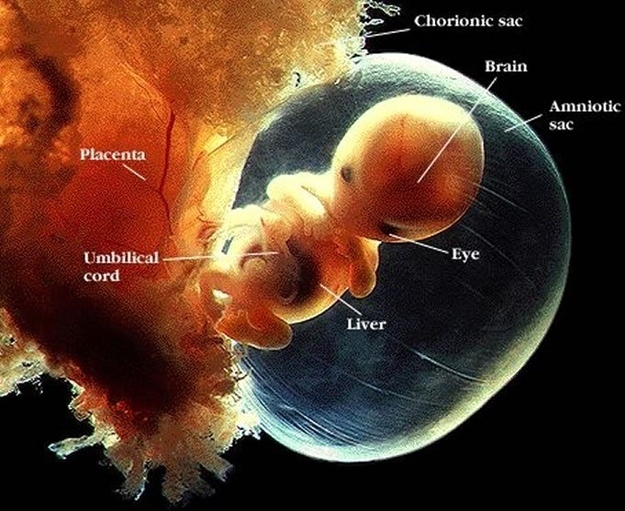 Recently, a friend shared with me a series of images of life in the womb. While I found them all absolutely breathtaking, I was particularly drawn to the one that showed a fetus at just seven weeks gestation. I’d always imagined a fetus at this stage to look more like a tadpole than a baby, but as you can see from the image to the left, while minute, s/he is clearly a developing human being with eyes, arms, legs, fingers and toes and more.
This was particularly striking to me because between my two youngest children, I miscarried a baby at this stage. I’m not sure that you can truly understand the pain of miscarriage until you experience one for yourself, or are closely bonded with others who do. I caught some inkling of what it was like when, as an expectant mother myself, others around me experienced losses. It was a bit terrifying honestly – because from the moment I saw that positive plus sign on my pregnancy test, a child had been born into my heart and soul – my dreams, my imagination, my vision for my life and my family’s life. So it was difficult to see others lose theirs in what seemed to be a cruelly random and inexplicable fashion.
And then, after two healthy, complication-free pregnancies and childbirths, it happened to me. I was more fortunate on one hand as it happened so early, I’d only known about my pregnancy for about three weeks. To this day, I don’t know how women who lose babies significantly later in pregnancy cope, and I was also very grateful that it happened before I went in routinely at 12 weeks to discover no fetal heartbeat because that would have broken my heart even more. However, on the other hand, the baby that I lost was too small to be seen, and in our culture, no personhood is conferred upon these tiny lost ones. We rarely name them. We don’t talk about them – even we women rarely discuss them, often because our friends are pregnant and worried enough about their own pregnancies as it is. Society expects us to grieve briefly and then move on. There will be another baby. There will be another thing.
But look at the photo. Eyes. Arms. Legs. Fingers. Toes. Clearly human. Clearly a person in the making.
In the aftermath of my miscarriage, I remember praying to God, and saying that I KNEW that this child of mine still existed – had been born into Heaven as they say. But then it hit me that the very saddest part for me was that the arms s/he had been born into weren’t mine. What better arms to be born into than God’s, and yet my baby being in Heaven without his mother was too much for my heart to bear.
I’m not one to claim that God spoke to me though I believe he does, always, quietly, communicate with all of us – in terms and with images that we can understand and that could help us see larger truths about him and about his love for us. There are distinct times in my life when I have received almost undeniable assurances, and I believe this was one of them. As I cried about my child being without me, the whisper that I caught was that my baby had indeed been born into Heaven – but into MY arms there.
How could this be?
I believe it is because God is not limited by time. That Heaven is not a distant reality, but unseen, all around us. That there is no waiting there – no loss.
In human time, I was here without my baby. But the incredible assurance I believe I received was that my baby wasn’t waiting there for me, but I was there too and we were together. (Not just me, but very likely everyone I’ve ever loved.)
We’ve always been together.
My husband and I went on to have another successful, healthy pregnancy once we got up the courage to try again six months later. The pain of my miscarriage was healed and faded, almost forgotten, consciously at least, in the process. Our lost baby had been due on Christmas Day, 2011 – nearly a year later to the day, our beloved Erica was born. We couldn’t imagine life without her, and somehow, life is exactly as it should be.
Lately though, as I face the end of my childbearing years, I have felt sometimes that our family was not complete. Our family needed a fourth child. My son with four sisters (two from my husband’s previous marriage) needed a brother.
It wasn’t until I saw the image like my lost child of seven weeks that I remembered.
I don’t need to have a fourth baby. I already have one. A real person is missing from my human life. This was not a depressing thought, but a freeing, joyful one. Life won’t ever be complete for us here on earth, but in acknowledging that, it CAN be complete. As complete as human existence can be.
When you lose a baby, you often hear that it was “Nature’s way” of weeding out the sick and the weak. If there is one thing I know about Triune God, it is that this is NOT the way they operate. I don’t believe that a single one of these is ultimately lost. Our losses here feel cruel and random – ultimately though, I believe they are not because this dimension, if you will, is not our real home. We just sojourn here. And if we mothers love these tiny, unseen ones — and oh, we do — so does God because he is the source of all of our love. They are not unseen to him. If we know what it is to desire and sacrificially love a child, it is only because he does too.
Dads love them too, as evidenced by a longtime friend’s recent Facebook post: “I miss you just as much today as I have every day for 19 years. Here’s to the day I never have to be without you ever again. Love Dad.”
Here’s to the day indeed, What happens here is not the final word. What happens here is painful and it’s natural that we grieve, even for a lifetime. But what it isn’t is hopeless. We have so much to hope for. Thank you, God!
~ by Jeannine Buntrock
Drop the binoculars
Filed under: By Jeannine Buntrock, William Paul Young | Tags: Doubt, Jesus, The Shack
Comments (5)  I had a rough few moments a few days ago. Instinctively, I knew that the comfort I needed could come only from God – but my prayer went something like, I know the comfort I need can only come from you, God…but…(whispered) I’m not completely sure that you exist.
That admission was not the result of what was going on – but was rather my doubt, always present at some level or another, finding a voice. There are times when I am absolutely certain that a loving God exists – that there is NO WAY any of what I experience in life could exist without him. But there are other times when I fear that it’s all just a great story and that I have been deluding myself. In that moment, I felt alone and lost.
But in an instant it all changed. A peaceful warmth like real arms enveloped me, and I knew that I was NOT alone. If there were words, they were, you’re not alone, dear one. I am here.
Just like Mackenzie in William Paul Young’s book, The Shack:
“Jesus?” he whispered as his voice choked “I feel so lost”
A hand reached out and squeezed his, and didn’t let go. “I know Mack. But it’s not true. I am with you and I’m not lost. I’m sorry it feels that way, but hear me clearly. You are not lost.”
And just like Mack, since my eyes were opened to his nearness and to my inclusion within the love relationship of the Triune God, if my sad, scared or desperate thoughts have turned to him, I have found that he is already with me, his hand reaching out and squeezing mine. And his words to me are, without fail, gentle, loving, and spoken with all the warmth and intimacy of a best friend, or my own mother. I know that I am known, understood, accepted, and truly, personally, beloved.
I don’t have to fast or pray or behave my way to him – all I have to do is open my too often screwed shut eyes to find that he is there and that he never left.
Comparing Jesus’ life on earth to a bird he was holding, Papa said about Jesus, “Although by nature he is fully God, Jesus is fully human and lives as such. While never losing the innate ability to fly, he chooses moment-by-moment to remain grounded. That is why his name is Immanuel, God with us, or God with you, to be more precise. (Paul Young, The Shack)
I can’t read that passage without tears swimming into my eyes. Somewhere, from deep within, I recognise it as truth. It’s difficult to wrap my mind around how exactly God can be here and everywhere – at once with me personally and with every person personally, while also composing the entire cosmos. But these are terms that I can understand. He didn’t leave or abandon us here on Earth any more than I would abandon my own children. He’s not somewhere else while we wait for him to return. He’s here.
Have you ever looked through binoculars at something inches away from you? The images in the lenses swim and there appears to be no form. It looks like nothing. I believe it’s the same with Jesus. If we pick up our binoculars and search for him in the distance, we miss him. But we don’t need binoculars because he isn’t far off in the distance. He’s near enough to touch. Father, Son and Spirit, near enough to touch – so big and vast that when we look at them, the images swim in our eyes and we think we see nothing. We don’t realise that the entire cosmos rests in the palm of his hand. More than that – that it Is an inseparable part of his heart. Yet he made himself small as well so we could relate and enter into a relationship with them.
…we want you to join us in our circle of fellowship. I don’t want slaves to my will; I want brothers and sisters who will share life with me. (Paul Young, The Shack)
It’s very normal – very human – to doubt. I will again, and I will be comforted and reassured again. Again and again and again. If we’re honest, we all doubt sometimes. But our doubt, while normal, comes from fear.
“So, why do I have so much fear in my life?” (Mackenzie asked.)
“Because you don’t believe. You don’t know that we love you. The person who lives by his fears will not find freedom in my love. I am not talking about rational fears regarding legitimate dangers, but imagined fears, and especially the projection of those into the future. To the degree that those fears have a place in your life, you neither believe that I am good nor know deep in your heart that I love you. You sing about it, you talk about it, but you don’t know it.” (Paul Young, The Shack)
When my eyes squeeze shut and, with the blackness, fear rushes in, it helps me to see it for what it is. Why do I doubt? Because I am afraid to be disappointed. Afraid that life is exactly what it appears to be – tragic, random, unjust – and death what it appears to be – final, irrevocable. Honestly I don’t, consciously at least, fear that God won’t be all that I hope he is. I am more likely to believe that there is no God than to believe in the stern, frowning, distant, conditional God I used to.
When I recognise my doubt as fear. it’s easier to arrest it. Because I recognise that a life lived in fear is wasted. And a lesson I have learned repeatedly is that when I have worried about something, I’ve almost always wondered why afterwards. I have seen that I need not have worried – that I wasted moments worrying.
I think it is unrealistic to go around perpetually certain. I am a bit put off by those who claim never to have even a moment of doubt and an answer to every question. Who knows though – perhaps they are the fortunate ones! I am who I am though, and I remain calmly confident, and yes, sometimes doubtful. In those moments, all I have to do is open my eyes – really open my eyes – and see that everything around me and inside me points to him. Everything is a miracle. The fact that I am conscious at all is a miracle. The three children who grew in my womb are complete miracles. A tree is a miracle. The earth is a miracle. There is no end to miracles and yet I take them for granted every day.
And so the cure for my doubt is gratitude. To open my eyes – drop the binoculars – look around me and within – and to marvel, with him, at what I see.
~ Jeannine Buntrock
No ifs…
Filed under: By Jeannine Buntrock, Christian Living, Relationships | Tags: Christian Living, Religion, Trinitarian Theology
Comments (4)  My all-time favourite book on the topic of parenting is Alfie Kohn’s Unconditional Parenting. In it, the author observes that while a parent may indeed love his/her child unconditionally, if he/she focuses on his child’s performance, meting out rewards and punishments accordingly, the child can come to see his parents’ love as conditional – tied to his performance. Without ever intending to, the message the parent can transmit and the child can receive is, I love you, if…
I love you if you obey/do what I say.
I love you if you perform/excel.
And as Kohn points out, to a child, it’s the message received that is heard, and that matters.
Think for a moment how it feels to a child to believe that his parents’ love for him is tied to his performance – that doing well along the way garners more love and acceptance, and that doing poorly means less love and acceptance. That she is not loved for herself so much as for her compliance and obedience. That parental love can be withdrawn at will.
Perhaps it’s not difficult to imagine, because perhaps this is how you felt, consciously or not, in relation to your own parents. And perhaps, like so many, this is how you have felt in relation to God for most of your life.
The book is a secular one, but on the topic of religion, Kohn notes:
While many religious people equate the idea of unconditionality with aspects of their faith, a case could be made, drawing on the holy books of Christianity and Judaism, that the deities in these religions offer the ultimate in conditional love. Both the Old and New Testaments repeatedly promise extravagant rewards for those who are properly reverent, and horrific punishments for those who aren’t. . . . Do what you’re told; you’ll become rich and get to watch your enemies die. Stray from the faith; you’ll suffer a range of consequences. . . . And for some believers, of course, even more significant blessings or curses await us after death. (102)
This is certainly not what we’re all about at Trinity and Humanity, but I believe that the observation is a fair one. It wasn’t until I encountered Trinitarian theology that I was able to stop seeing God as a distant but micro-managing deity sending blessings when I was “good” and cursings when I was “bad.” Only once I was freed to open my eyes to the fact that his love for me was not tied to my performance in any way – not even in a backhanded or double-edged way – did I truly, finally feel loved. I recognised that that was unconditional love – the only kind there is. Conditional love isn’t really love.
I believe that because God’s love is truly unconditional, I could be…you fill in the blank…and he’d still love me. It’s true he wouldn’t want me to keep hurting myself or others, but he wouldn’t love me more if I did, and less if I didn’t. It surely upsets him greatly to see the pain I cause myself and others. But rather than meting out rewards and punishments in an attempt to modify my behaviour, I believe he continues to work gently in me. Whether or not that work will be finished by the end of my physical life is unlikely, but I believe that it will be finished. The kind of healing we all need to become everything we could and were created to be is unlikely to occur in this life. We have only to look around us to see that this is true, and we only see a fraction of people’s private, hidden struggles. But our greatest hope and expectation is that this life is not all there is or that will be.
What a relief it is to see that there are no prerequisites to his love and acceptance. That because he exists outside of time, he has seen our completion. We may be liars, thieves, murderers and adulterers in this life – but he has seen our future healing and completion. He is the author and finisher of it. So, broken, damaged and imperfect as we are in this life, he sees beyond it to who we are becoming, thanks to him. I really believe he takes great joy in our journeys – our steps forward and even those backwards because it’s all part of the process.
I’m trying to put down my heavy burdens. I am trying to recognise the loud voices in my head that say I am only lovable and acceptable if I do certain things and not others as the divinely vanquished phantoms that they are. Honestly, I hear them less and less every day.
I see life as an endurance race – not a sprint I need to win or a perilous trek to the summit of Mt Everest. I’m trying to be compassionate to my fellow journeymen with broken feet or legs and broken hearts. There are many and it is all of us to some degree. Jesus walks lovingly with us all at our pace. Someone’s behaviour may look “unChristian” to we who have been raised in the church, but the worst thing we can do, as Christians, is to take potshots at them along the way. Or to gang up on them, “take stands,” and tell them that they must change, if they are to be or feel included.
When we do, we make these people feel alone, unloved, unlovable and not included. But they are not alone, and they are loved and included. If God’s love is unconditional – and that’s the only kind of real love there is – then ours should, to the very best of our ability, be too. If we give someone the feeling that they are only included if, even if it’s not what we mean to do, then we’ve laid a burden at their feet that will only weigh them down in the journey. If God wishes to make them not this or not that, let’s let him do it. That is what it will take. Him, not us. His ways are so often not ours – his are never harsh words and judgement couched in love – not “tough love,” but pure love.
Within the all-encompassing love of the Father, Son and Holy Spirit, there are no ifs. So may it be with us.
~ by Jeannine Buntrock
Love – the only name that matters
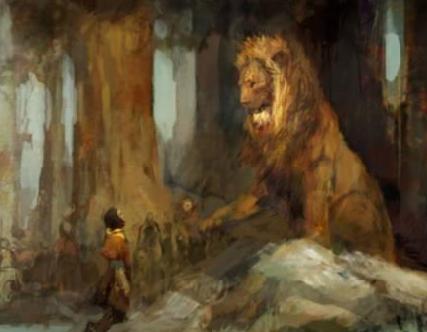 My kids and I recently concluded reading through C.S. Lewis’ Chronicles of Narnia. Since I had stopped after The Lion, the Witch and the Wardrobe as a child myself, I enjoyed them every bit as much as my kids. I ate them up hungrily actually.
It’s been interesting to read about some of the controversies sparked by the series, and also C.S. Lewis’ own words regarding his work. Entire books have been written on the topic, and as is so often the case, it’s difficult to know exactly what to think or believe. I find it interesting that Lewis described the stories as coming to him – and there were a number of events in the final two books particularly that resonated with me powerfully. When I finished reading The Last Battle to my kids, I could barely speak for being so choked up. I felt that if all they ever understood about their futures came from that book, there would be enough hopeful certitude to last them their lifetimes.
One of these events was the reaction of Aslan to Emeth, a Calormene who had spent his life serving and seeking the god he had been raised to believe in – Tash. Emeth relates:
But the Glorious One bent down his golden head and touched my forehead with his tongue and said, Son, thou art welcome. But I said, Alas, Lord, I am no son of thine but the servant of Tash. He answered, Child, all the service thou hast done to Tash, I account as service done to me.
Aslan continues:
Therefore if any man swears by Tash and keeps his oath for the oath’s sake, it is by me that he has truly sworn, though he know it not, and it is I who reward him. And if any man do a cruelty in my name, it is Tash whom he serves and by Tash his deed is accepted.
When Emeth persists, saying that he spent his entire life seeking Tash and therefore surely can’t be acceptable to Aslan, the Lion says:
Beloved, unless thy desire had been for me, thou wouldst not have sought so long and so truly.
And you wonder why the Chronicles were considered controversial!
The idea that this could be true – that humans can worship or serve any “god” and, if love is there, God counts it for him, is controversial indeed. But it’s also extraordinarily wonderful!! – a cause for unending celebration.
It’s also worth noting that this account takes place once Emeth has already passed “through the stable door.” His physical life has ended before he encounters Aslan.
I realise we can’t know for certain – C.S. Lewis was a mere mortal, if not inspired. But I can’t help feeling that what he described here is precisely as it should be. When,
4 Love is patient, love is kind. It does not envy, it does not boast, it is not proud. 5 It does not dishonor others, it is not self-seeking, it is not easily angered, it keeps no record of wrongs. 6 Love does not delight in evil but rejoices with the truth. 7 It always protects, always trusts, always hopes, always perseveres. 8 Love never fails. (I Cor. 13:4-8) *
When God is all of those things.
Someone knocked on my door a few months ago and tried to tell me that God wished to be called by one name only (Jehovah), and was as angered at being called by a different – even similar – name as I would be at being called by the wrong name.
I disagree. I don’t believe that God cares what name we call him by. My child could call me by a name other than Mama (even an insulting one) and I’d remain his mama. She could forget she ever had a mother, and I’d remain the person who loved her from the moment I knew she was coming, who birthed her, and for whom rarely a minute passes without consciously thinking about her. And never one without loving her more than my own life. This is so without thought, intention, effort or taking credit on my part. It just is. Most parents would sooner stop breathing than stop loving their children. (Even with the final cessation of breath, I believe that this love goes on and remains.) This is all, also, as it should be. Every human knows it, however deep down.
We get it wrong when we look at our own characteristics and imagine God from there – but I do know that if there is anything good in people – and there is – it is just like moon reflecting the true light of the sun. But as the moon would be invisible, in pitch blackness, without the sun, so would we without the Son, Father and Spirit.
I look around me at people of all cultures and religions – and I see that moonlight in all of us. Not one of us is perfect or has it all figured out, but Love remains, no matter what creed, or lack thereof, under which we we live.
7-10 My beloved friends, let us continue to love each other since love comes from God. Everyone who loves is born of God and experiences a relationship with God. The person who refuses to love doesn’t know the first thing about God, because God is love—so you can’t know him if you don’t love. This is how God showed his love for us: God sent his only Son into the world so we might live through him. This is the kind of love we are talking about—not that we once upon a time loved God, but that he loved us and sent his Son as a sacrifice to clear away our sins and the damage they’ve done to our relationship with God. 11-12 My dear, dear friends, if God loved us like this, we certainly ought to love each other. No one has seen God, ever. But if we love one another, God dwells deeply within us, and his love becomes complete in us—perfect love! (I John 4:7-11, The Message)
Love – it’s the only name that matters.
~ Jeannine Buntrock
* The Message translation reads I Corinthians 13 as follows:
3-7 If I give everything I own to the poor and even go to the stake to be burned as a martyr, but I don’t love, I’ve gotten nowhere. So, no matter what I say, what I believe, and what I do, I’m bankrupt without love.
Love never gives up.
Love cares more for others than for self.
Love doesn’t want what it doesn’t have.
Love doesn’t strut,
Doesn’t have a swelled head,
Doesn’t force itself on others,
Isn’t always “me first,”
Doesn’t fly off the handle,
Doesn’t keep score of the sins of others,
Doesn’t revel when others grovel,
Takes pleasure in the flowering of truth,
Puts up with anything,
Trusts God always,
Always looks for the best,
Never looks back,
But keeps going to the end.8-10 Love never dies. Inspired speech will be over some day; praying in tongues will end; understanding will reach its limit. We know only a portion of the truth, and what we say about God is always incomplete. But when the Complete arrives, our incompletes will be canceled.
I love it! 🙂
Motherhood – Taking Care of the Invisible
Filed under: By Jeannine Buntrock, Love, Relationships | Tags: Motherhood
Comments (2)  As a mother, I am deeply concerned with getting motherhood right. This is a tall order with no end to the number of aspects to consider: nutrition, education, discipline, enrichment, spirituality and so on — let alone happiness and letting our children experience authentic, unhurried childhoods. It’s exhausting, especially when I lack so many answers personally, and don’t always know exactly what to think or believe about the conflicting answers I do have.
In her book The Way Back Home, Peggy O’Mara, writes:
All that is really important is invisible: love, God, air.
She goes on to say that what makes mothers unique is that they take care of the invisible.
I love that. The first two are obvious to me, but the last — the air — I take to mean things like home, and the atmosphere there. The things that let children know in their souls that they are loved and that they belong.
In her famous TED talk “The Power of Vulnerability,” researcher and author Brene Brown noted that in her extensive research on human connection:
There was only one variable that separated the people who have a strong sense of love and belonging from the people who struggle for it. And that was, the people who have a strong sense of love and belonging believe they are worthy of love and belonging. That’s it. They believe they are worthy.
She goes on to call these people the whole-hearted and to describe them as living from a deep sense of worthiness.
So it turns out that perhaps my entire job as a mother really boils down to helping my children establish a deep sense of worthiness. The kind that can’t be shaken from the outside. Father, Son and Spirit are working every minute of every day to accomplish this through me because in their eyes, we are all worthy. We all belong with, to and in him. Religion has done an awfully good job of convincing people that they belong if. I don’t believe there are any if’s with God though, and for a child to grow up to be one of the whole-hearted, there must not be if’s when it comes to worthiness or belonging in their homes.
But it turns out it’s not enough to try to do this for my children. They won’t believe it about themselves if they don’t see that I believe it about myself.
As Brene Brown researched what made people have a deep sense of worthiness that gave them this strong sense of love and belonging, she discovered that what they all had in common was a) courage to be imperfect and to tell the story of who they were with their whole hearts, b) compassion to be kind to themselves first and then to others, c) connection derived from letting go of who they thought they should be in order to be who they were, and d) that they embraced vulnerability.
Dear mothers, we’re never going to be perfect or get it all right. It seems that rarely a day goes by that I don’t hang my head in shame at an action or inaction in relation to my children. But we don’t have to be perfect or get it all right. We shouldn’t be afraid to be who we are and to be vulnerable — we shouldn’t try to be who we are not — and we must care for ourselves too.
The compassionate way we view our own children’s stumblings, God views ours. The tears we cry for their pain, he cries for ours. The way their beauty and worthiness shines in our eyes, ours shines in his. The best gift we can give our children is that conviction about ourselves — that we are worthy no matter what — that we are loved no matter what — and that no matter what, we belong.
Happy Mother’s Day!
~ Jeannine Buntrock
__________________________________________________________________
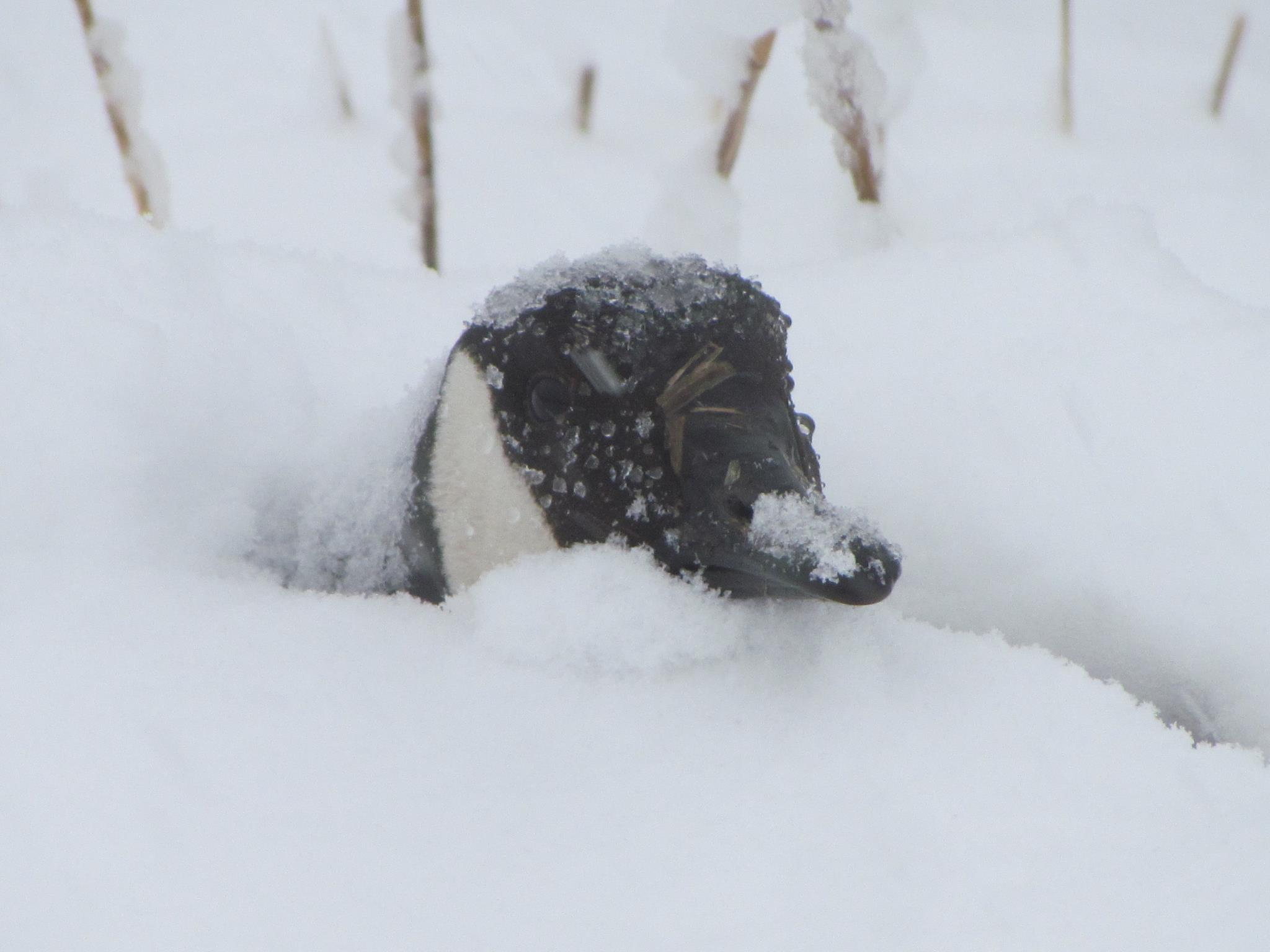 Just a week ago where I live, nearly 20 inches of snow fell on one day in the rarest of May snowstorms. Apparently if you accumulated all the snow that has fallen in May since the 1800’s, it would add up to less than what fell here on just one day. The record was blown by 2000%.
When visiting a local nature reserve, naturalist Greg Munson snapped a photo of a mother goose buried up to her beak in snow. She had been sitting on her nine eggs for two weeks, and no amount of snow was going to move her.
A few days later, the same mother goose was photographed now contending with flooding melted snow as it threatened her nest and eggs. She had built her nest on solid ground, well away from the water’s edge, but life had done what it does to all of us – been impossible to predict.
I’m quite sure the mother goose and goslings’ story ends well!
Live like a Narnian (even if there isn’t any Narnia)
Filed under: By Jeannine Buntrock, Uncategorized | Tags: C.S. Lewis, Faith, Hope, Jesus, Trinity
Comments (3)  My kids and I have recently read through C.S. Lewis’ timeless Chronicles of Narnia, beginning with The Lion, the Witch and the Wardrobe. We are currently reading The Silver Chair, the second to last novel. Just last night, we read as the serpent-witch attempted to enchant the children, the marshwiggle Puddleglum, and Prince Rilian — to trick them into believing that Narnia, the sun and Aslan were all just a dream, and that the only reality is the cold, hopeless, pitch black underworld where they currently reside. She very nearly succeeds, and might have if it had not been for Puddleglum, who says:
Suppose we have only dreamed, or made up, all these things — trees and grass and sun and moon and stars and Aslan himself. Suppose we have. Then all I can say is that, in that case, the made-up things seem a good deal more important than the real ones. Suppose this black pit of a kingdom of yours is the only world. Well, it strikes me as a pretty poor one. And that’s a funny thing, when you come to think of it. We’re just babies making up a game if you’re right. But four babies playing a game can make a play-world which licks your real world hollow.
While I find that there is so much good in our world, there are also times that it seems to be a black pit of darkness too. I am able to conceive of a much better, brighter world — but in so many ways it seems impossible that while humans walk the planet, wars will ever truly cease, that no child will starve or go homeless and unloved, that our environment will not continue to be poisoned, that people will not exploit each other and so on.
Is it just a hollow, empty, hopeless dream I have that things will be better? That this is NOT all that there is? It’s certainly not just my dream. I believe we all share it. Most of us know love when we see or experience it. We recognise injustice. Literature is full of stories that describe real, devoted, sacrificial love, and the struggle of humanity against injustice. From whence does this common dream come? Which is the true reality in our universe, and which is the dream?
I believe that, like Scrubb, Jill, Prince Rilian and Puddleglum, we are in many ways temporarily asleep, dreaming, and lost in the darkness. It’s easy to conclude that all there is is what we can physically see and touch — and that the darker sides of the human experience — loss, death, heartbreak — triumph despite our struggles against them.
Yet the Father, Son and Holy Spirit are constantly whispering to us — reminding us of what I believe we all know deep down — that these things will never triumph. That all battles have been won. There has already been a final end to war, disease, heartbreak, even death. We remain asleep to that reality, but it exists nonetheless. It is the true reality, and ours is the dream.
Puddleglum concludes:
That’s why I’m going to stand by the play-world. I’m on Aslan’s side even if there isn’t any Aslan to lead it. I’m going to live like a Narnian as I can even if there isn’t any Narnia…We’re leaving your court at once and setting out in the dark to spend our lives looking for Overland…
Like Puddleglum, I intend to live my life with the full assurance that there is better — infinitely better — life to come for all of us, and that Father, Son and Spirit have included us all there. My eyes will remain firmly fixed on the horizon, but also on what is directly underneath my feet. Because Jesus hasn’t left us here to dream a dark dream alone. He has joined us right here, exactly where and as we are. Glimpses of him can be found absolutely everywhere in our world. For those of us still walking planet Earth, the fullness is just yet to come.
~ Jeannine Buntrock