Archive for the ‘By Jonathan Stepp’ Category
Why?
Filed under: By Jonathan Stepp, Christian Living, Gospel, Love, Relationships | Tags: John 21, St. John, St. Peter, Suffering, Theodicy
 Comments (2)
  “Why?” seems to be the question that God is least likely to answer. Consider, for example, the story of Peter and John on the beach with the risen Jesus in John 21. Jesus predicts Peter’s death, prompting Peter to look back at John and ask “what about him?” Jesus replies “If it is my will that he remain until I come, what is that to you? You must follow me.”
In a sense Peter is asking “why?” Why must I suffer? Why do others receive blessings that I don’t receive? Why do I have this particular life and not the life that I want? Job also asked these sorts of questions and he, like Peter, received the answer that seems like it isn’t an answer: “what is that to you? you must follow me.”
Some might argue that God doesn’t answer any questions, but I have found that some questions do have answers. Does God love us? Yes. Will God be faithful to us? Yes. How should we live? Love God and love our neighbors. Some questions God has answered, but faced with the “why” of life – especially the “why” of suffering – we seem to mostly hear God simply saying “trust me.” She usually doesn’t tell us why and we don’t even know why she won’t tell us why.
In the face of such mystery we are prone, like Peter, to start comparing ourselves with others. That path quickly leads to jealousy. From there it is just a short hop to doubting God’s goodness. After all, if I am focused on what God is doing in someone else’s life then I am most likely missing what God is doing in my own life. And when I stop paying attention to God’s work in my life then I start doubting that God is good and even begin to wonder if God is doing anything at all.
There is a wonderful line in the collect for Proper 12 in The Book of Common Prayer. It says “may we so pass through things temporal that we lose not the things eternal.” Suffering is temporary – and so are wealth, power, and good looks. All the things that make us ask “why me?” or make us ask “why him and not me?” – all those things are temporary. When Jesus says “what is that to you? you must follow me,” he is telling us to look to what is eternal so that we do not lose it. What is eternal? The Father, Son, and Spirit, the love of God, and the love of our friends and family. May we learn to pass through the things that make us say “why?” in such a way that we do not lose the things that make us say “thank you.”
~ Jonathan Stepp
Psalm 23
Filed under: By Jonathan Stepp, Christian Living, Gospel, Perichoresis, Prayer, Trinity | Tags: Faith, Psalm 23, Psalms
Comments (4)  Lord, you are my Shepherd,
every little thing gonna be alright.
You’ve given me enough to eat,
and a place to sleep,
and people who love me.
And you’ve shown me how to follow you
and find the meaning of my life.
I’ve also had bad times,
and bad times
will come again,
but I won’t be afraid, just as long as you stand by me.
In the midst of all the anxiety and pain,
you give me bread and wine and oil,
Father, Son, and Holy Spirit,
your life creating my life.
Surely, in light of all this,
I can believe that you are my everlasting home.
~ Jonathan Stepp
Eight Sentences on the Human Condition
Filed under: Bible, By Jonathan Stepp, Christian Living, Gospel, Perichoresis, Trinity |
Comments (2)  Some lines from the Gospels just jump out at you. I picked these eight sentences because they are reflective of what we are all experiencing in our relationship with God. These lines are the cry of humanity to the Trinity:
1. Go away from me, Lord, for I am a sinful man! (Luke 5:8) God’s self-revelation is not, to begin with, a pleasant or hopeful experience. There is a burden, a heaviness, about God’s presence which C.S. Lewis sometimes called “the weight of glory.”
2. Lord, if you had been here, my brother would not have died. (John 11:32) We are really quite dysfunctional in our relationship with God – we are constantly yo-yoing between “go away!” and “why aren’t you here?”
3. I believe; help my unbelief! (Mark 9:24) Is there any more profound statement of what it means to try to live a life of faith? We cannot do it, we can only open ourselves to let the Holy Spirit share with us the faith of Jesus – the faith he has in his Father’s goodness
4. Lord, to whom can we go? You have the words of eternal life. (John 6:68) Even when we don’t understand what is happening or what God is trying to tell us, we can, at least, know that we are trusting the right one when we are trusting Jesus.
5. My God, My God, why have you forsaken me? (Matthew 27:46) This is the great cry of humanity – both believers and non-believers alike. For every one of us the day will come when these words are squeezed out of us by the crush of suffering. It is no accident that Jesus himself offers these words up to God on our behalf.
6. My Lord and My God! (John 20:28) What else can we say when we see life conquer death, destruction turned into resurrection, and despair rising again as joy?
7. Lord, you know everything; you know that I love you. (John 21:17) Eventually doubt and faith, life and death, suffering and resurrection, all become the Father’s hidden and surprising ways of bringing us fully into the life she shares with the Son and the Holy Spirit.
8. We recognized him in the breaking of the bread. (Luke 24:35) And so, whenever we break the bread and drink the cup we proclaim the struggle of our faith and the faithfulness of the one who has given himself fully to us.
~ Jonathan Stepp
Juneteenth and the Gospel
Filed under: By Jonathan Stepp, Church, Evangelism, Gospel, Perichoresis | Tags: Juneteenth
Comments (2)  Today is Juneteenth – the day that celebrates the announcement of emancipation to the slaves of Texas on June 19, 1865. I’ve always liked Juneteenth for what it meant in American history and also the analogy it provides for the gospel.
The slaves in Texas had legally been emancipated on January 1, 1863, when Lincoln issued the Emancipation Proclamation and freed all slaves in states in insurrection against the U.S. government. Since a great war was taking place at the time, however, those slaves did not hear about – and the U.S. government was unable to enforce – the Proclamation until Texas was militarily defeated and government forces arrived to occupy Galvestion in June 1865.
Therein lies the analogy for the gospel: humanity was emancipated from sin and death 2,000 years ago when the Son of the Father destroyed death by his resurrection and took humanity into the life of the Trinity through his ascension. But like the slaves of Texas, much of humanity has not yet heard or believed the good news of their liberation. Like the slaves of Texas, we are already free but we are not yet fully living in that freedom.
The Diocese that I’m a part of has a slogan: Walk in the Way, Widen the Walls, Wake up the World. I think that last phrase is a perfect description of the Church’s calling: as the Union army awakened the slaves of Texas to the freedom that already belonged to them, so we are called to wake up the world to the freedom that is already theirs in Christ.
~ Jonathan Stepp
The Mystery of Faith
Filed under: By Jonathan Stepp, Easter, Gospel, Liturgy, Perichoresis, Worship |
Comments (3) 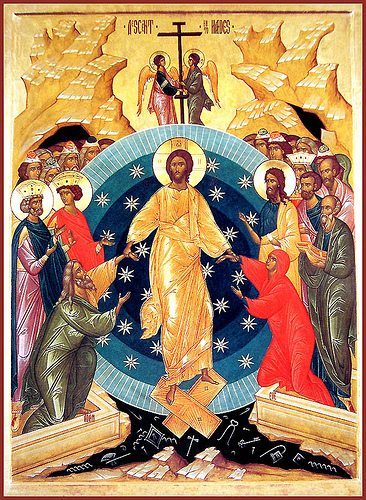 Every Sunday we proclaim the mystery of faith: Christ has died, Christ is risen, Christ will come again. During this Easter season the proclamation that Christ is risen takes on special significance for us, of course.
There is an interesting text in the scriptures that ties to this proclamation. In fact, this text was the Epistle reading on Easter Sunday this year. St. Paul tells us:
If you have been raised with Christ, seek the things that are above, where Christ is . . . for you have died, and your life is hidden with Christ in God. When Christ who is your life is revealed, then you also will be revealed with him in glory. ~ Colossians 3:1, 3-4
Do you hear how the liturgy echoes the scripture? The Christ who died is now raised and he will be revealed again someday. But the scripture offers us an even deeper dimension: we also have died – with Christ – and we also have been raised with Christ, and we also will be revealed in glory when he comes again.
The mystery of faith is not only that something amazing happened to Christ. The mystery of faith is that we are bound up in, included in, and a part of what has happened Christ. His death is our death and his resurrection is our resurrection.
This is the power of the story of Jesus: the revelation that God the Father loves you as much as she loves her son Jesus Christ. God did not hide God’s face from Jesus or abandon him to the grave. By the mystery of faith you can therefore know that your life is hidden with Christ in God and that the Father will never abandon you.
~ Jonathan Stepp
See!
Filed under: By Jonathan Stepp, Gospel, Perichoresis | Tags: Ash Wednesday, Lent
Comments (2)  From the Epistle reading for Ash Wednesday: See, now is the acceptable time; see, now is the day of salvation!
This is our biggest problem. We just don’t see. Of course God is invisible – but that’s not the kind of seeing that St. Paul is talking about. He is talking about the kind of seeing that means perception, understanding, and insight into the world as it really is. With this spiritual sight we are able to perceive that God was, in Christ, reconciling the world to himself. With this spiritual sight we are able to know that Christ became sin and therefore we have become the righteousness of God.
Seeing that today is the day of salvation means that we are able to perceive our spouses, our children, our friends – and even our enemies – as they really are: beloved of the Father, reconciled in Christ, and expressing the fruit of the Holy Spirit. And we are able to perceive ourselves as we really are: beloved, reconciled, and bearing the fruit of the Spirit.
St. Paul seems to cry out in the Spirit to us: See! Open your eyes! Look around you and know that God is at work in every nook and cranny of life. His cry is the cry of Lent: the call to awaken out of our winter slumber, to open our eyes to the spring of Easter Day, and to see – to really see, and know, and understand – that God has not abandoned us. In Christ he has saved us from fear and blindness and death.
What’s the Point of all the Miracles in the Gospels?
Filed under: Bible, By Jonathan Stepp, Christian Living, Evangelism, Gospel, Ministry, Perichoresis, Prayer, Spiritual Warfare, Trinity | Tags: Gospels, Jesus, Miracles, Robert Capon
Comments (8)  I think this is an important question because we don’t see these sort of miracles taking place today. I know, some Christians would have you believe that we do, but let’s be honest – we don’t. Despite the best efforts of televangelists, sixth-hand stories in forwarded emails, and “you have to see this” posts on Facebook, we do not see people walking on water, rising from the dead, or having demons cast out of them as the Gospels (and the book of Acts) depict it.
There’s a longstanding tradition in Christianity, and this is reflected in the Gospel accounts themselves, that says the miracles that Jesus performed (and those performed in his name by the Apostles) were meant to prove Jesus’ Divine origin as the Son of God. That alone would be explanation enough for why these sorts of miracles no longer occur: having served their initial purpose in proving Jesus’ Divinity, they are no longer needed.
But we want them don’t we? When it’s our child who’s sick, when we are facing death, and when defeat seems to be overwhelming victory we long for God to step in with what Robert Capon has called “right-handed” power and prove to the whole world that he exists and that he is on our side. Instead, we see God acting with what Capon calls “left-handed” power. We see her working in littleness, lostness, and death.
Let me suggest another reason for the miracles of the gospels: what if – and this is just a “what if” – the miracle stories of the Gospels are meant to show us the general uselessness of miracles for the cause of growing the Kingdom.
Consider the arc of Jesus’ story for a moment: a miracle worker appears in Galilee, claiming a special relationship with God, and his miracles result in what? A mass conversion of the whole nation? A turn of the people away from darkness to light? Not exactly. Instead, he is rejected and crucified. The right-handed power of God is proven to have little to no effect in bringing people to trust God. Instead, it seems to be the opposite: the more God acts with power in Jesus the more people angrily reject him. Even Jesus makes this point in the story of Lazarus and the Rich Man when he says “. . . neither will they be convinced even if someone rises from the dead.” (Luke 16:31)
There’s something in our nature that says “if only God would show up with power; if only God would work a miracle, then I would believe and so would others and then we would be convinced that God really loves us.” It is this wishful thinking that sends so many Christians chasing after the miraculous in Facebook videos. But the Gospels themselves reveal that our thinking is more wishful than factual. The Gospels tell us that God did show up with power and did work miracles and all it did was freak us out and cause us to try to kill him.
Perhaps one reason for the miracles in the Gospels is to help us understand where and how we should be looking for the work of the Father, through the Son, in the Holy Spirit: not in the flashy, powerful, and supernatural, but in the pain of our crucifixion, in the darkness of the tomb, and in the places at the margins of society where no one cares except the one who is Love.
~ Jonathan Stepp
P.S. There’s no need to post your personal miracle stories in the comments section. I too have experienced the inexplicable and been encouraged that the Father loves me in Jesus because of it. This post is about the kind of public events that we see in the Gospels.
Happy St. Stephen’s Day!
Filed under: By Jonathan Stepp, Evangelism, Gospel, Perichoresis, Trinity | Tags: St. Stephen, St. Stephen's Day
Comments (6) 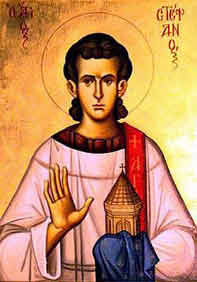 The Christmas message can be dangerous. Why did the angry crowd stone St. Stephen to death? If you read the story in Acts 7 then you see that a lot of factors are at work: Stephen is confronting them with God’s calling to Israel, the gospel, and even their own sin. But the moment that causes them to “rush together against him” is when he says:
I see the heavens opened and the Son of Man standing at the right hand of God!
It is the Christmas message that finally riles up the crowd to kill him: the message that divinity and creation, heaven and earth, Trinity and Humanity, have been joined forever in the incarnation of the Word as the child born at Bethlehem.
What is it about this message that is so offensive to us? At some primal level we would rather imagine God far away from us, sitting on some throne in heaven demanding our obedience, than admit the truth that God the Father has drawn us into her life through the humanity of the Son and immersed us in the loving life of the Holy Spirit. God has drawn infinitely near to us in Christ and drawn us infinitely near to himself. That message is truly good news, if we will receive it as such.
We give you thanks, O Lord of glory, for the example of the first martyr Stephen, who looked up to heaven and prayed for his persecutors to your Son Jesus Christ, who stands at your right hand: where he lives and reigns with you and the Holy Spirit, one God, in glory everlasting. Amen. (Book of Common Prayer)
~ Jonathan Stepp
Will Heaven Be Communist?
Filed under: By Jonathan Stepp, Christian Living, Gospel, Perichoresis, Trinity | Tags: Economics, Heaven, Jesus
Comments (8)  When I say communist, I don’t mean the totalitarian nightmare of the 20th century. I mean the seemingly naive, idealistic 19th century philosophy of communal society that said “from each according to his ability, to each according to his need.”
Before you jump to any conclusions consider the following questions:
- Do you think we will have money in heaven?
- Will good money managers live in a nicer part of heaven than bad money managers?
- Will the life of the world to come be a life of “haves” and “have nots”?
It seems to me that the answer to these questions is “no”. It’s no wonder that Jesus was so ambivalent about money and at times was quite negative about the accumulation of wealth. His vision was focused on what is to come – on what is eternal – and the accumulation of wealth just isn’t something that has much of a future. Jesus gives us a vision of the kingdom of heaven in which human society is beyond money, beyond wealth accumulation, and beyond a brokenness in which a few have too much and many do not have enough (consider, for example, the Parable of Lazarus and the Rich Man.)
Now here’s the really weird part: Jesus said that, in him, this Kingdom of God has come near to us. In some sense we are already living this life and called to change our minds (repent) and begin living in anticipation of the fullness of the coming of this new world. And that raises a final question:
If we believe all this then how should we be living now?
~ Jonathan Stepp
Five Reasons to Celebrate Communion Every Sunday
Filed under: By Jonathan Stepp, Church, Gospel, Perichoresis, Worship | Tags: Communion, Eucharist, Worship
Comments (4) 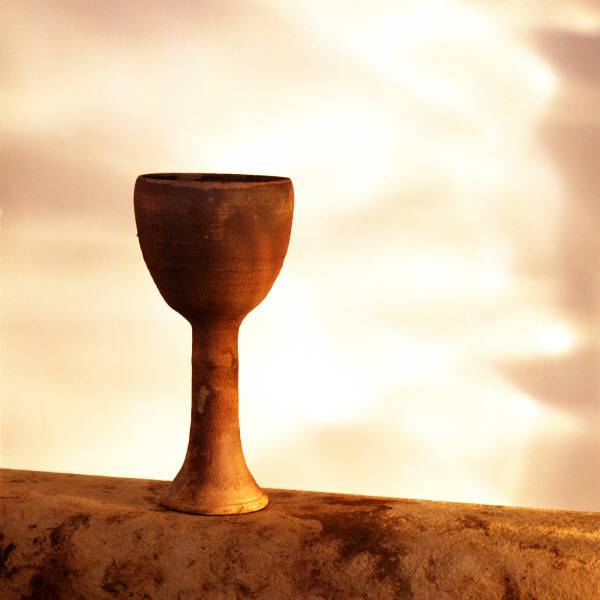 Does your church celebrate communion every Sunday? If not, here are five reasons you should consider it:
1. Jesus gave us the bread and wine as the regular reminder of the gospel. The gospel is the good news that God the Father, Son, and Holy Spirit has established communion with humanity, forgiving us of our sins and drawing us into the dance of God’s life. When Jesus took the bread and wine and said “this is my body and blood” he gave us an outward and visible sign of the gracious, but hidden, truth of our communion with God through Jesus. No other reminder of the gospel, such as sermons or songs, was given to us in the way that the bread and wine were given.
2. Jesus gave us the bread and wine as the means of thankful response to God’s grace. The grace of God is the gift of God’s own communion-life as Father, Son, and Holy Spirit. To such a magnificent and gracious gift we can only respond with thanksgiving. The bread and wine are often called the “Eucharist” because that is the Greek word for thanksgiving. Other forms of response to God’s grace – such as altar calls and sinners’ prayers – may have their place but they were not given to us by Jesus in the way that the bread and wine were given.
3. Jesus gave us the bread and wine so that we would have something tangible to take hold of. There’s a story about a small boy who was frightened of a thunder storm one night and jumped in bed with his parents. His Dad said “don’t you know that God will protect you?” and the boy replied, “yes, but sometimes I need someone with skin on.” Words, songs, prayers, and emotions are all real but intangible. The bread and wine give our bodies a much needed material and tangible encounter with the presence of God in our world.
4. Jesus gave us the bread and wine to remind us of himself and the story of his life on our behalf. St. Paul says that as often as we take the bread and wine “we proclaim the Lord’s death until he comes.” In the Eucharist we are encountering the past (the Lord’s death) and the future (his return) in the immediacy of the present moment. No other act of worship enables us to experience the life of Jesus in that way.
5. Celebrating communion every Sunday will make it more special, not less. Almost all churches have music, prayers, and sermons every Sunday and no one ever says “we should only have a sermon once a month” or “we should only pray once a quarter.” Only communion receives such treatment. And yet, Christians for 2,000 years testify to the fact that the more we receive Jesus’ body and blood in the bread and wine the more deeply we appreciate it and the more we are shaped into his image.
How could your church begin celebrating communion every Sunday, if you wanted to? By making it “available” and not required. Simply say, “we’re going to conclude each service with bread and wine for the benefit of any who would like to receive it.” Don’t make a big deal out of trying to get everyone to participate, just offer the feast of the Lord’s table and see how the Holy Spirit moves among the people who are gathered there
~ Jonathan Stepp